
Source Institutions
Source Institutions
Add to list Go to activity
Activity link broken? See if it's at the internet archive
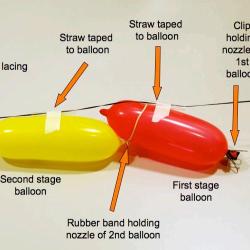
In this Engineering Design Challenge activity, learners will use balloons to investigate how a multi-stage rocket, like that used in the Interstellar Boundary Explorer (IBEX) mission, can propel a satellite to a specific orbit. Participants will construct a two-stage balloon rocket that will be required to reach a particular location on the balloon track, simulating the proper orbit to be reached by the IBEX satellite. If you need an audio version of this material, the file is compatible with screen reading software such as Adobe Acrobat Reader.
- 5 to 10 minutes
- 10 to 30 minutes
- $1 - $5 per student
- Ages 8 - adult
- Activity, Lesson/Lesson Plan, Model
- English
Quick Guide
Materials List (per student)
- two long balloons that can inflate to approximately 1' (30 cm) long; Note: Do not use animal shape twist balloons
- 20' (6 meters) of vinyl craft lacing, any bright color
- two 4" (10 cm) long plastic, non-bendable straws
- masking tape
- one 3" (8 cm) rubber band that is at least 1/8" (0.25cm) wide
- one 1.25 inch (3 cm) binder clip
- hand-operated balloon pump
Subjects
-
Earth and Space Science
-
Astronomy
- Probes, Satellites and Spacecraft
-
Astronomy
-
Engineering and Technology
-
Engineering
- Aerospace Engineering
-
Technology
- Transportation
-
Engineering
-
Physical Sciences
-
Motion and Forces
- Gravity
- Momentum and Velocity
- Acceleration
-
Motion and Forces
-
The Nature of Science
-
The Scientific Process
- Conducting Investigations
-
The Scientific Process
-
The Nature of Technology
-
Technology and Society
- Impacts of Technology
-
The Design Process
- Problem Solving
- Troubleshooting and Maintenance
-
Technology and Society
Informal Categories
- Model Building
- Toys
- Transportation
Audience
To use this activity, learners need to:
- see
- be mobile
- touch
Learning styles supported:
- Involves hands-on or lab activities
Other
Components that are part of this resource:
Includes assesments for student learning:
This resource is part of:
Access Rights:
- Free access
By:
Rights:
- All rights reserved, NASA,
Funding Source:
- NASA