
Source Institutions
Source Institutions
Add to list Go to activity
Activity link broken? See if it's at the internet archive
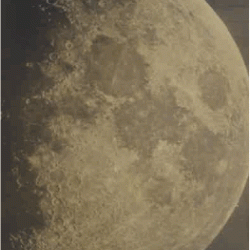
In this activity, learners will use Google Sky to observe features of the night sky and share their observations. Learners partake in a "Telescope Treasure Hunt" as they look for suggested astronomical objects, and then they can design their own hunt for another learner. An included reading, "Step Back in Time" introduces learners to Maria Mitchell, the first American woman to discover a new comet, and a recommended book can take this historical connection further. This activity will allow learners to practice their observation skills by looking at things carefully, drawing sketches, and writing short descriptions as well as consider how astronomy technology has evolved over the years. This lesson guide includes tips and useful information specifically for parents and educators.
- Under 5 minutes
- 10 to 30 minutes
- free per student
- Ages 4 - 11
- Activity, Lesson/Lesson Plan
- English
Quick Guide
Materials List (per student)
- Directions sheets (page 4-5 of PDF)
- ThinkAbouts sheet (page 6 of PDF)
- Step Back in Time sheet (page 3 of PDF)
- computer with Internet access
- Google Sky
- pen or pencil
- book Maria's Comet (optional)
Subjects
-
Earth and Space Science
-
Astronomy
- Stars and Galaxies
-
Solar System
- The Moon
- The Planets
- Asteroids and Comets
-
Astronomy
-
Physical Sciences
-
Vibration and Waves
- Light and Optics
-
Vibration and Waves
-
Mathematics
-
Data Analysis and Probability
- Data Analysis
- Data Collection
- Data Representation
-
Data Analysis and Probability
-
Engineering and Technology
-
Technology
- Information and Communication
-
Technology
-
The Nature of Science
-
The Scientific Process
- Conducting Investigations
- Gathering Data
- Formulating Explanations
- Communicating Results
- Science as a Career
-
The Scientific Process
-
The Nature of Technology
-
Technology and Society
- Impacts of Technology
- Technology and History
-
The Design Process
- Invention and Innovation
-
Technology and Society
Informal Categories
- Computers
- Literature
- Nature and Environment
Audience
To use this activity, learners need to:
- see
- see color
- read
- use keyboard
- use mouse
- touch
Learning styles supported:
- Links STEM to other topics of interest such as arts and humanities
- Involves hands-on or lab activities
Culture, ethnicity, and gender
-
Girls
- Acknowledges this group's contributions to STEM
- Addresses bias against this group
- Identifies role models or mentors in STEM fields from this group
Other
Components that are part of this resource:
Includes alignment to state and/or national standards:
This resource is part of:
Access Rights:
- Free access
By:
Rights:
- All rights reserved, Smithsonian Institution,
Funding Source:
- Verizon Foundation, http://thinkfinity.org/about.aspx