
Source Institutions
Source Institutions
Add to list Go to activity
Activity link broken? See if it's at the internet archive
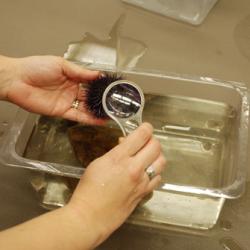
In this activity, learners observe tide pool animals in a touch tank to consider how they survive. Questions are provided to introduce physical (non-living) and biological factors that put these animals at risk, including salinity changes (how salty the water is), drying out, crashing waves, competition for space, and protection from predators. Additional background is provided about tides, waves, and types of rocks the animals attach to. The activity is written for use in an aquarium or museum, but could be done anywhere, including actual tide pools.
- 30 to 45 minutes
- 10 to 30 minutes
- $5 - $10 per group of students
- Ages 4 - 11
- Activity
- English
Quick Guide
Materials List (per group of students)
- Plastic tubs large enough to hold 2-3 different animals
- Seawater
- Aerator and pump
- Tide pool animals such as a sea star, turban snail, and/or sea cucumber
- Towels for drying hands
- Picture tiles or drawings of physical and biological factors at the rocky seashore: low tide/high tide, waves, wind, sun, air, predators, people etc.
- Picture or poster of tide pools at the rocky seashore
- Hand lenses for examining organisms
- Butcher Paper or wipe boards
- Markers
- Books about the rocky seashore
Subjects
-
Earth and Space Science
-
Earth Structure
- Oceans and Water
-
Earth, Moon and Sun
- Tides
-
Earth Structure
-
Life Sciences
-
Diversity of Life
- Animals
-
Diversity of Life
-
The Nature of Science
-
The Scientific Process
- Asking Questions
- Formulating Explanations
-
The Scientific Process
Informal Categories
- Animals
- Outdoor Activity
Audience
To use this activity, learners need to:
- see
- touch
Learning styles supported:
- Involves hands-on or lab activities
Other
Includes alignment to state and/or national standards:
This resource is part of:
Access Rights:
- Free access
By:
Rights:
- All rights reserved, Birch Aquarium at Scripps, 2009
Funding Source:
- National Science Foundation, NSF OCE-0731338